
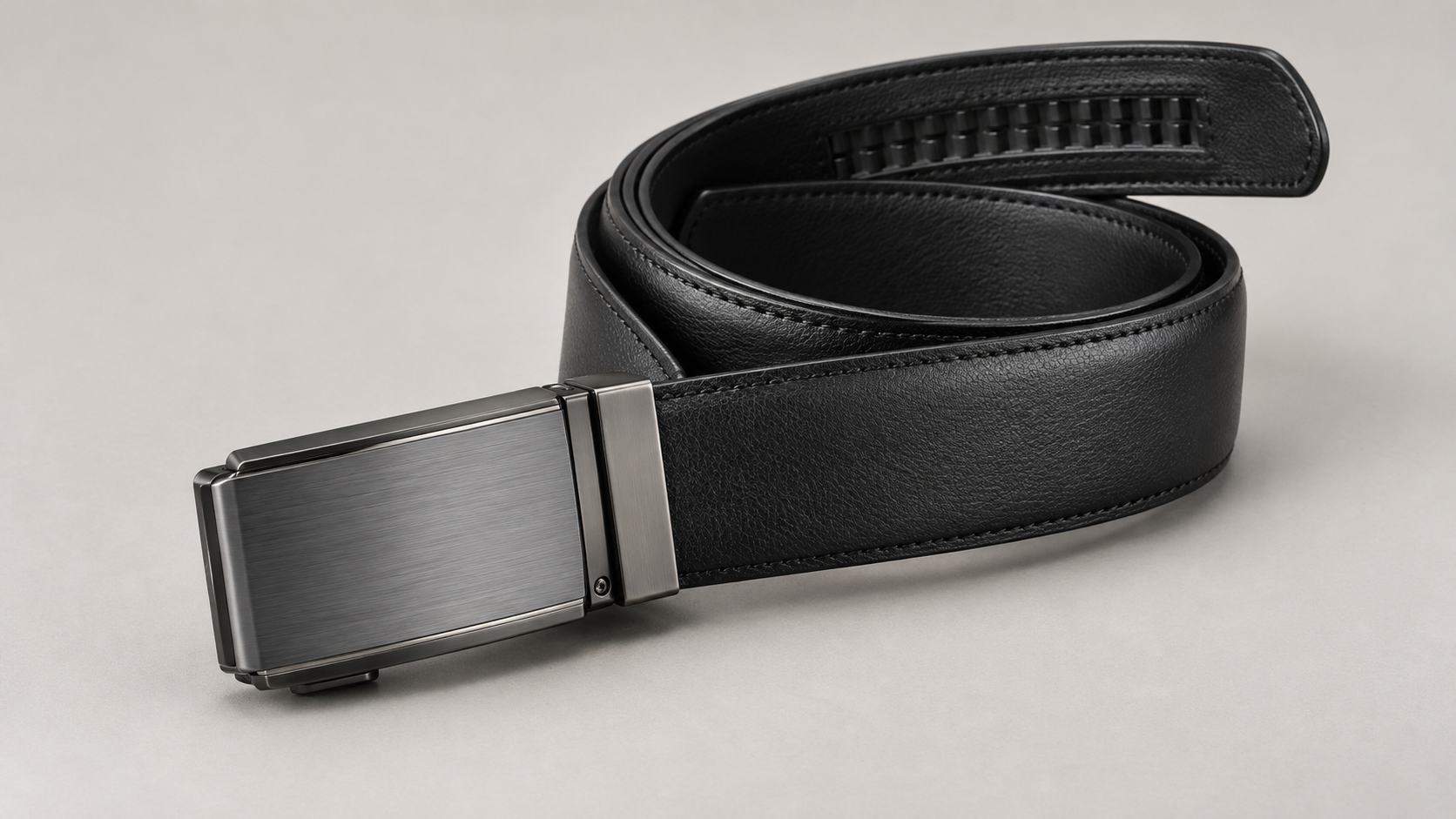
An automatic buckle belt should be sourced as a working system, not as a leather strap plus a separate piece of hardware. The buckle pawl, release lever, track, clamp, strap thickness, and reinforcement must work together. If one connection is wrong, a belt that looks acceptable can slip, jam, release poorly, or pull free in use.
When we review an automatic belt brief at Wlapparel, we therefore ask for more than a product photo. We translate the intended look, market, fit, materials, branding, packaging, and performance requirements into one development file. This guide shows buyers what to specify before sampling and what to approve before bulk production.
What Is an Automatic Buckle Belt?
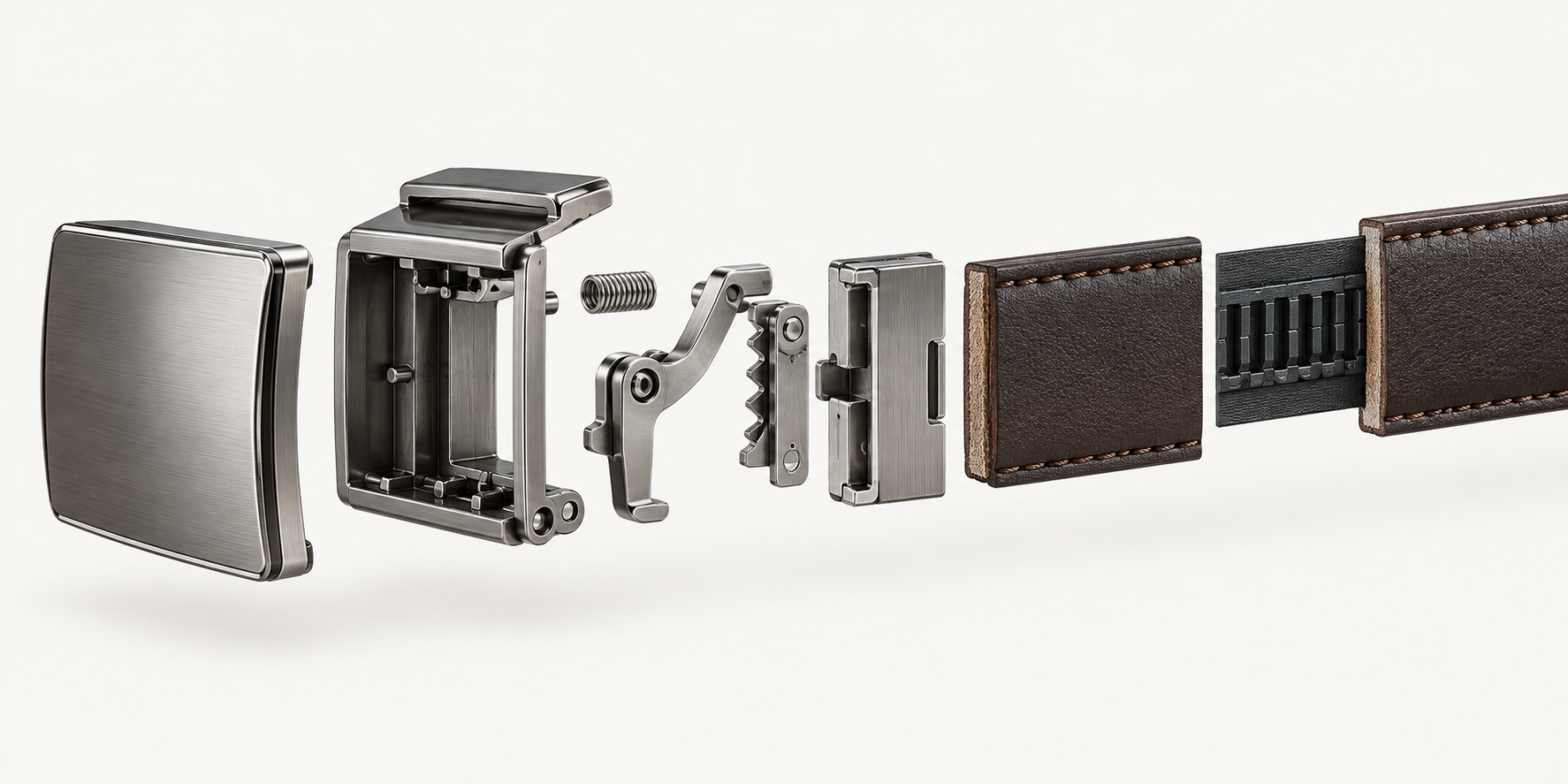
An automatic buckle belt—also called a ratchet belt, track belt, click belt, or no-hole belt—uses a toothed track on the underside of the strap. A pawl inside the buckle engages that track, while a lever releases it. The wearer can select positions along the usable track instead of relying on a small number of punched holes.
The apparent simplicity hides four critical connections:
- The pawl must engage the track securely.
- The track must remain straight and attached to the strap.
- The buckle clamp must hold the strap construction.
- The strap must pass through the buckle with suitable clearance and flex.
Approve these connections in the finished belt, not only in component samples.
Start With a Complete Automatic Belt Specification
A clear specification reduces interpretation and makes quotations easier to compare. At minimum, define the following fields.
| Specification area | What the buyer should confirm | Why it matters |
|---|---|---|
| Wearing position | Natural waist, trouser waist, or hip | Changes length, curvature, and fit range |
| Strap dimensions | Width, thickness range, total length, tip shape | Must match buckle clearance and the intended garment |
| Size system | Finished sizes, usable adjustment range, trim-to-fit or fixed-size format | Affects SKUs, instructions, and returns risk |
| Face material | Exact leather or non-leather construction, grade, color, grain, and finish | Controls appearance, claims, cost, and consistency |
| Backing and reinforcement | Lining material, internal reinforcement, bonding, stitching | Influences flex, clamp retention, and long-term shape |
| Track | Material, length, tooth geometry, placement, and attachment method | Determines adjustment range and engagement |
| Buckle | Dimensions, base material, mechanism family, clamp, and lever direction | Controls compatibility, weight, function, and cost |
| Surface finish | Plating color, gloss, brushing direction, texture, and protective requirements | Creates the visible quality standard |
| Branding | Logo artwork, location, method, size, depth, and orientation | Prevents distortion and mechanism interference |
| Construction | Edge paint, stitching, thread, tip, and keeper details | Defines the approved appearance and durability plan |
| Packaging | Protection, labels, barcode, instructions, box or hangtag | Reduces scratching and supports retail operations |
| Inspection | Functional checks, cosmetic limits, sampling plan, and reference sample | Gives production and QC an agreed decision rule |
Do not use “genuine leather,” “vegan leather,” or “premium metal” as complete specifications. Name the construction accurately and request supporting documents where a market or claim requires them. In the United States, the FTC Leather Guides specifically address representations about leather and imitation-leather composition.
Match the Construction to the Product Position
The same mechanism can support different retail concepts, but each concept needs a different balance of material, weight, finish, and packaging.
Business and dress programs
A smooth or fine-grain leather face, controlled edge color, and a clean plated buckle can support a formal position. Check buckle thickness under a jacket, polish consistency, and the way the strap bends around the wearer. A visually heavy buckle may work in product photography but feel unbalanced on a narrow strap.
Casual and fashion programs
Pebble grain, embossed surfaces, seasonal colors, brushed finishes, or a custom logo plaque can create differentiation. The design review should still protect lever access, track engagement, and strap clearance. Decorative geometry cannot be allowed to obstruct the mechanism.
Gift and ecommerce programs
Presentation and user instructions become part of the product. If the strap is trim-to-fit, approve the trimming direction, size marks, minimum retained track, diagrams, warning language, and replacement policy. Packaging should prevent buckle-to-buckle contact and visible surface damage in transit.
Uniform, golf, and repeat-use programs
The brief should define the actual use environment. Confirm required flex, contact with moisture or perspiration, cleaning expectations, and functional test methods. Do not assume a material is water-resistant or suitable for a particular use based on appearance alone.
Our automatic ratchet belt manufacturing program covers multiple strap materials, buckle directions, logo options, colors, and packaging formats. We confirm the final combination through development rather than treating these choices as interchangeable.
Approve the Sample as a System
An attractive sample is not automatically a production-ready sample. During design and development, we recommend recording decisions in stages.
1. Appearance approval
Check color under agreed lighting, grain, gloss, edge paint, stitching, buckle finish, logo position, and proportions. Keep a signed physical finish reference where visual consistency matters.
2. Fit and usability approval
Test the belt on the intended garment and at the intended wearing position. Confirm that the usable track covers the size claim, the release lever is accessible, the strap enters smoothly, and the loose end sits as designed.
3. Functional approval
Cycle the complete assembly using a buyer-approved method. Check engagement at the beginning, middle, and end of the track; release action; slippage; clamp retention; track attachment; and visible damage. The test method, load, number of cycles, conditioning, and pass/fail limits must be agreed for the project.
4. Packaging approval
Pack the finished belt exactly as it will ship. Confirm buckle protection, fold radius, moisture-control requirements if any, label data, barcode readability, instructions, and carton assortment.
The approved sample should be linked to the current drawing, bill of materials, color/finish references, packaging artwork, and inspection plan. If a component changes later, record the change and decide whether reapproval is required.
Build a QC Plan Around Failure Modes
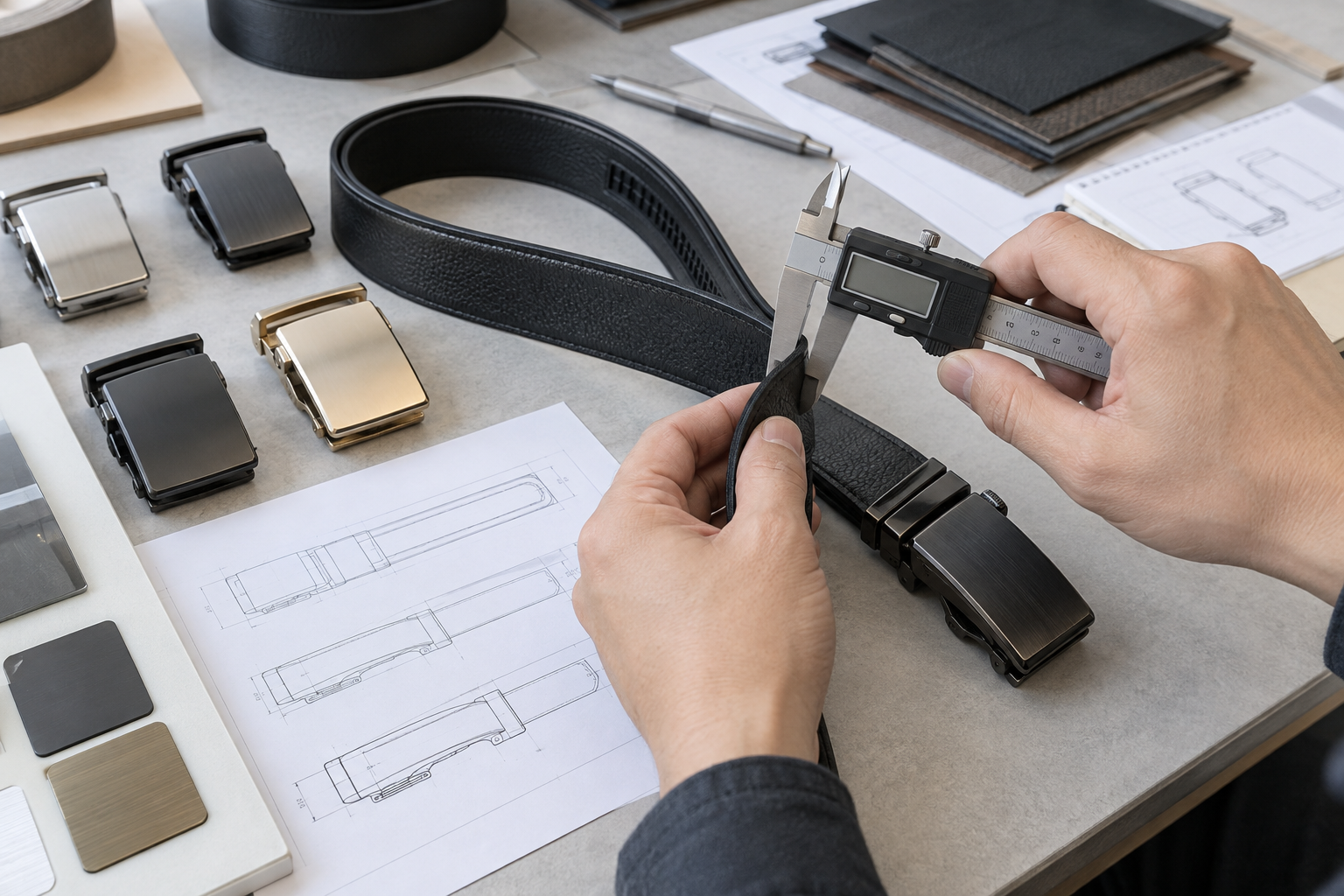
Automatic belts require both cosmetic and functional inspection. A practical plan checks incoming components, in-process assembly, and finished goods.
Incoming-component checks
- Compare face material, backing, track, buckle, and packaging with approved references.
- Check buckle dimensions, lever movement, finish color, scratches, pits, sharp edges, and logo placement.
- Confirm strap thickness and width at the points that interact with the buckle.
- Verify track geometry and the attachment materials or process specified for the order.
In-process checks
- Check that the track is straight and positioned consistently.
- Confirm clamp alignment and strap insertion depth.
- Review bonding, stitching, edge paint, tip shape, and lining alignment.
- Test engagement and release before packaging hides or constrains the product.
Finished-product checks
- Compare appearance and dimensions with the approved sample and specification.
- Test locking and release across the usable adjustment range.
- Check for slippage, pullout, sticking, abnormal play, and damage after the agreed test.
- Verify size labels, material wording, country-of-origin data where required, barcode, instructions, packaging, and carton assortment.
An AQL label by itself is not a complete QC plan. Buyers still need to define defect classes, inspection level, acceptable limits, test frequency, and the reference documents used to make decisions.
Treat Claims, Labels, and Traceability as Product Data
Material and performance wording should be reviewed before packaging is printed. The FTC’s US Leather Guides warn against misleading composition and characteristic claims for covered products, including belts. If a strap combines leather, reconstituted leather, textile, or synthetic layers, describe it accurately for the target market.
For EU programs, the General Product Safety Regulation may affect economic-operator, safety, traceability, and distance-sale information. Requirements depend on the product, role, market, and sales channel. Buyers should provide their market-specific compliance brief and approve final labels and online-listing data with qualified advisers.